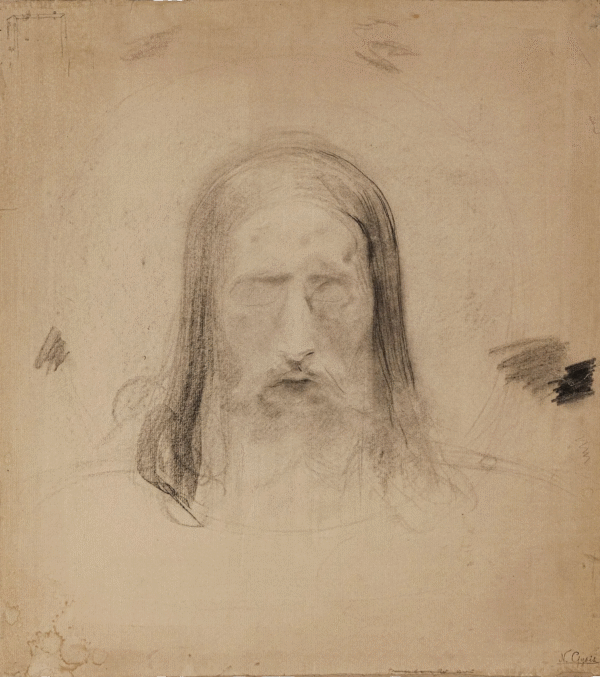
Nikolaus Gysis (1842-1901) – Study of the Head of Christ Pantocrator
- Certified provenance
- Secure payments
- Worldwide shipping
Nikolaus Gysis (1842-1901), Study of the Head of Christ Pantocrator, charcoal on cardboard mounted on a secondary support, c.1893, 59.5 x 54 cm, signed.
Provenance: from the artist’s estate in Munich.
Bibliography: Didaskalou, Konstantinos, Der Münchner Nachlass von Nikolaus Gysis, Munich 1993, p. 192, no. 4 925, ill. 294.
Exhibition: Municipal Art Gallery of Thessaloniki, Nikolaos Gysis 1842 to 1901, exhibition 1999.
This Head of Christ reveals the full graphic talent and artistic mastery that define the work of Nikolaus Gysis. A central figure of the Munich School, Gysis was a complete and complex artist who, as the critic William Ritter wrote in 1901, might today enjoy the fame of Edward Burne-Jones or Gustave Moreau had he not been born in Greece. His oeuvre fully confirms this view, as he succeeded in uniting a European nineteenth century Symbolist sensibility with the Greek Orthodox figurative tradition. The gravitas of this Christ embodies that synthesis.
The image draws directly on the iconography of Christ Pantocrator, a central motif in Orthodox icons. The term Pantokrátor derives from the Greek meaning “He who rules over all” or “Ruler of the Universe”, a title attributed to Christ in the Greek biblical texts, particularly in the Book of Revelation. This is not a suffering Christ, but a risen and reigning one. Through a refined and almost immaterial line, Gysis seems to let the image emerge from the paper itself. The face, recalling even the model of the Shroud of Turin, appears strikingly real and almost physical, yet it radiates a sacred presence that transcends the earthly realm.
Born in 1842 on the island of Tinos, Gysis first trained at the School of Arts in Athens before continuing his studies at the Academy of Fine Arts in Munich, where he later became professor. He spent most of his career in Germany while remaining deeply connected to Greek culture. Today his works are held in major public collections, including the National Gallery of Greece and the Neue Pinakothek.