
HERMANN GEHRI (1879-1944)
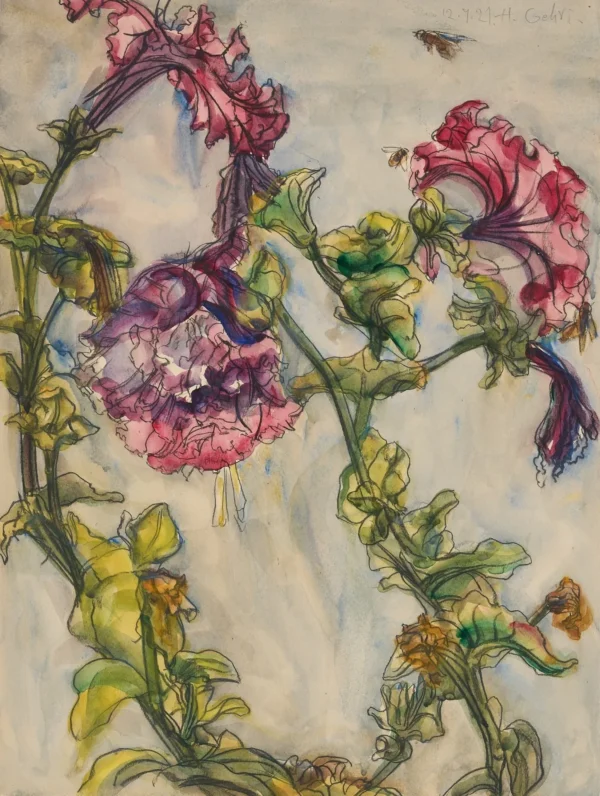
Petunias with Bees
1 800€
Petunias with Bees
Watercolor and ink on paper, 12 July 1921, signed and dated.
Three large trumpet flowers dominate the sheet, their frilled, ruffled petals unfurling in deep crimsons and mauves against a pale, almost luminous ground. The stems twist and branch with botanical authority, carrying buds at every stage — tight and green at the lower edges, blazing open at the centre, already shrivelling and spent at the margins. Around them, three bees move through the composition with quiet purpose, each one rendered with the same attentiveness as the flowers themselves: small, precise, entirely alive.
Gehri builds the image in his characteristic double register. The ink line comes first — fluid, searching, tracing each petal’s curl and each leaf’s serrated edge with a draughtsman’s confidence. Over it, the watercolor floods in: warm purples pooling in the throats of the flowers, acid yellows crackling through the foliage, pale blue washes opening the background into something between sky and light. The two layers never quite coincide, and it is in that slight tension — between the drawn and the painted, the structured and the dissolved — that the work finds its vitality.
There is nothing symbolic here, and yet nothing merely decorative either. Gehri looks at these flowers the way a scientist might, and feels them the way a poet does. The bees are not ornament; they are the logic of the image — the reason the flowers exist, the agents of their continuation. In the lower corners, spent blossoms curl and brown. In the centre, the great purple flower hangs open, extravagant and briefly perfect.
Dated 12 July 1921, this sheet belongs to an exceptional group of botanical watercolors produced by Gehri at the height of his powers, in the same summer as several of his major figurative compositions. It was a period of extraordinary creative intensity, the year after his appointment as Professor of Figure Drawing at the Badische Landeskunstschule in Karlsruhe — and one that would define his reputation before the years of persecution to come.
Dismissed from his professorship by the National Socialists in 1933 and labelled a entarteter Künstler — degenerate artist — in 1937, Gehri spent his final years as a free artist in his native Freiburg. He died on 27 November 1944, when a bombing raid destroyed the city, his studio, and the greater part of his life’s work. Every surviving sheet is a small miracle of preservation.
Related products
-
OLOF THUNMAN (1879-1944)
At Dusk, View of Gamla Stan, Stockholm
-
LOUIS MOE (1857-1945)
600€Book illustration for “The Finnepriest”
-
ALBERT LYNCH (1860-1950)
3 500€The Possessed
-
ERNST NORLIND (1877–1952)
8 000€Skånelänga