OLOF THUNMAN
Biography
Olof Thunman (1879–1944) was born in Uppsala, in the student residence Imperfektum on Västra Ågatan, the son of a Swedish schoolteacher. After secondary studies and a few unfinished years at Uppsala University in Nordic languages and history, he turned to art, studying at Stockholm’s Royal Academy of Fine Arts and its etching school from 1902 to 1906, where he won a medal in his final year and met his future wife. As a student, he took part in 1905 in the very first exhibition of the Konstnärslaget artists’ league.
In 1907 he met the young Evert Taube, whom he mentored in art and poetry, forming a lasting friendship. In 1916 he married the painter Carin Kuylenstierna (1879–1968), a mayor’s daughter from Axvall in Västergötland. The couple lived in the Uppland archipelago until 1923, then at Skälsjön near Lövstabruk, before settling permanently in 1928 in the gatehouse of Noor’s Castle in Knivsta, where Thunman spent the rest of his life, constantly roaming the countryside on foot or by bicycle, sketchbook in hand, recognizable in his grey homespun suit and leg wraps — the very image later cast in the statue erected in his honor.
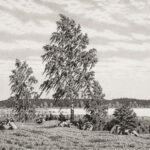
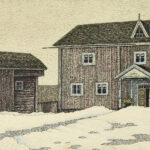
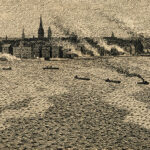
His art, like his poetry, was rooted in the cultural landscape of Uppland. He began with impressionistic, twilight-toned landscapes, mostly marine subjects, before shifting toward topographically precise drawings and washes in ink, pastel, and chalk. For some thirty years his drawings illustrated the lavish Christmas issues of the newspaper Upsala Nya Tidning, depicting the buildings, landscapes, and people of the region, with breaking waves in the archipelago a favorite motif; he produced nearly 600 works in all, though his first solo exhibition came only in 1942.
His poetry appeared in collections including Pan spelar (1919), Ölandssånger (1927), Fornbygd och färdvägar (1929), Mark och vindar (1935), and Visor från vidd och vrå (1939). His best-known poem, Vi gå över daggstänkta berg, set to a melody of uncertain origin, became a classic of Swedish popular song. His work reflects a broader Scandinavian fascination with folklore, national identity, and the symbolic power of nature, including motifs drawn from Viking heritage.
Thunman died in October 1944 in Uppsala. A memorial fund in his name had already been established in 1929, and a statue now stands outside Särsta Inn in Knivsta, near the school named after him; his grave in Uppsala’s old cemetery bears a memorial stone raised in 1954. Interest in his work has revived in recent decades, with a major monograph published in 2005 and an exhibition devoted to him in 2007.