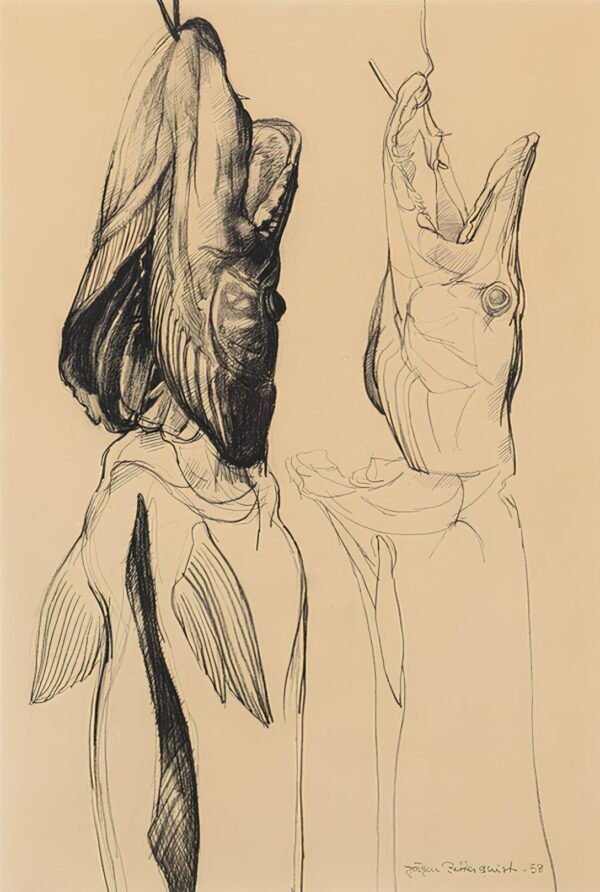
Pencil on paper. Signed and dated upper right, “Jörgen Zetterquist – 58.”
Image dimensions 63 x 42 cm. Frame dimensions 89 x 67 cm.
The drawing depicts two pike suspended by cord, presented side by side in contrasting states of finish: on the left, the fish rendered in dense, worked hatching that models the muscular curve of the body, the layered fins and the sheen of the scales; on the right, its counterpart sketched in a lighter, more linear touch, the elongated jaw and single round eye left legible against the pale ground, the underlying structure of bone and cartilage still visible beneath the sparing line.
The technique combines fine pen or pencil hatching — dense and directional in the shaded flank, sparse and searching in the outline of the second fish — with the natural tone of the paper left bare to stand in for light. The juxtaposition of a highly worked study beside a barely-there one gives the sheet the character of a working page: two attempts at the same motif, seen from two angles and pushed to two different degrees of resolution.
The hanging fish is a long-standing motif in Northern still-life and study drawing, descending from the game and fish pieces of Dutch and Flemish tradition, in which the suspended animal becomes a pretext for close anatomical observation — the play of light across scale and skin, the articulation of jaw and fin. Zetterquist, trained in the rigorous figurative discipline of Nils Wedel and Endre Nemes at Göteborg, takes up this tradition here in a spirit of direct observation rather than allegory: the pike is studied as a structure of interlocking planes and textures, in the same searching, realist manner he brought to his portraits, self-portraits and figure studies. The sheet reads less as a finished composition than as a study from life, the kind of working drawing typical of an artist for whom drawing remained, throughout his career, a discipline practised as much as exhibited.