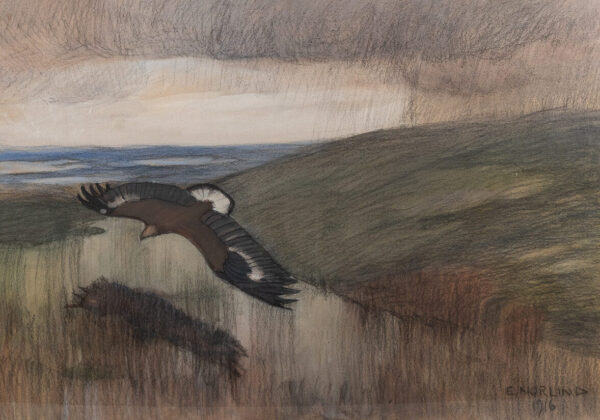
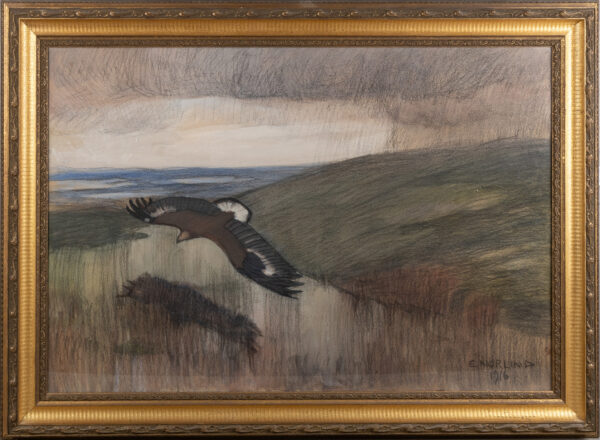
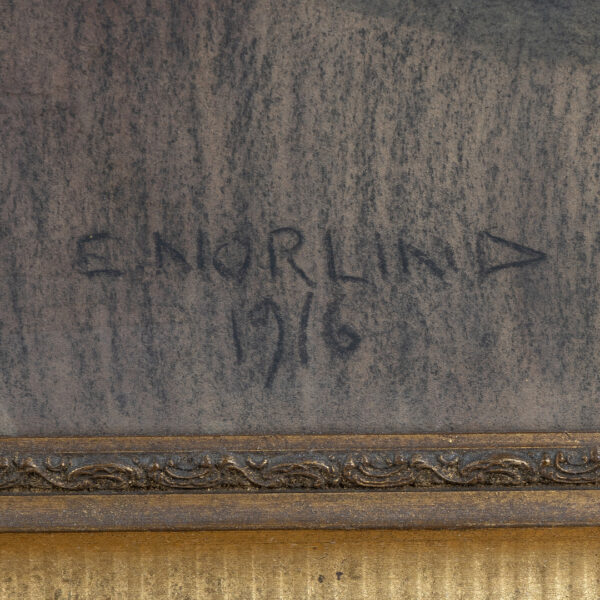
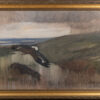
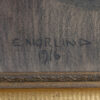
Watercolor, pencil and chalk on paper, 1916, signed and dated, 66 × 97 cm.
A white-tailed eagle crosses the sheet at low altitude, its wings fully spread, its body pulled taut in the momentum of flight. Below, the land opens into a coastal marsh — reeds, wet ground, and the distant glimmer of sea — rendered in long, hatched strokes of pencil and chalk that dissolve into pale washes of ochre, olive, and dusty rose. Above, a heavy sky presses down, its texture built from dense, layered pencil work that gives the paper the weight of stone. The eagle alone is painted: warm chestnut brown, its flight feathers mapped in dark graphite against the light, its white tail catching the last brightness in the composition. Everything else recedes. The bird holds the sheet.
The technique is entirely characteristic of Norlind’s graphic work, where drawing and painting are never fully separated. His graphic work frequently focused on bird motifs, and here the eagle is treated with the same combination of ornithological precision and elemental feeling that defines his finest sheets. The marsh landscape — flat, windswept, melancholic — is unmistakably Scanian: his landscape interpretations were atmospheric and often melancholic, shaped by literary influences and deeply rooted in the Scanian province.
Dated 1916, the work belongs to a particularly charged moment. His paintings of this period were often dark and limited in palette — sombre, introspective, attuned to the mood of a continent at war. Sweden remained neutral, but the cultural atmosphere of those years pervades the image: the solitary bird, the vast indifferent sky, the land emptied of all human presence. There is grandeur here, but also exposure.
Norlind was born on 25 April 1877 in the Vellinge Parish in Skåne, Sweden. He began his education as a philosophy candidate in Lund in 1898 before transferring to the study of art, attending schools in Dachau and Paris. He settled at Borgeby Castle in Skåne with his companion Hanna Larsdotter, where they held cultural salons hosting luminaries such as Rainer Maria Rilke, Anders Österling, and others. A painter, writer, and violinist, he was also perhaps best known in his lifetime for his poster advertising the Baltic Exhibition in Malmö in 1914. His work is represented in the Nationalmuseum in Stockholm, the Gothenburg Museum of Art, Malmö Museum, and Prince Eugen’s Waldemarsudde.