Hermann Gehri (3 September 1879 – 27 November 1944) was a German painter, lithographer, and illustrator, born and raised in Freiburg im Breisgau, where he also met his tragic end. The son of a master carpenter, he completed his secondary education at the Berthold-Gymnasium in Freiburg before embarking on his artistic training. From 1899 to 1905, he initially studied architecture at the Karlsruhe Institute of Technology, before transferring to the Dresden Academy of Fine Arts and subsequently to the Grand Ducal Baden Academy of Fine Arts in Karlsruhe, where he attended the painting class of Ludwig Schmid-Reutte.
Following a year of compulsory military service, Gehri undertook a study stay in Japan in 1907–08. From 1908 to 1912 he worked as a freelance artist and traveled extensively to Italy, Vienna, Paris, and Amsterdam, before taking up a teaching post at the School of Applied Arts in Berlin in 1912. During the First World War, Gehri initially supported the work of the Red Cross, then served as a soldier on both the Eastern and Western Fronts from 1916 to 1918, was wounded in action, and spent the end of the war in a military hospital.
In 1920, Gehri was appointed Professor of Figurative Drawing at the Baden State School of Art in Karlsruhe. Endowed with a strong pedagogical aptitude, intellectual vitality, and a clear teaching style, he thrived in this role and attracted a large number of students. As an illustrator, he contributed drawings to Axel Lübbe’s *Der Becher der Phantasie* (1919) and to Gustav Münzel’s *Die Geschichte vom Schorschel* (1920); he also authored and illustrated his own book of silhouettes, *Märchen und Gespenster*, in 1920.
Following the transfer of power to the National Socialists, Gehri was dismissed from his post in 1933 on the grounds of alleged deficiencies in his educational approach. He returned to Freiburg, his birthplace, where he lived as an independent artist until 1944, when he was killed in a bombing raid that also destroyed his studio and the greater part of his work. Most of the pieces that survived are now held at the Augustinermuseum in Freiburg.
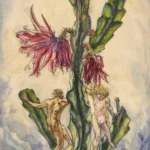
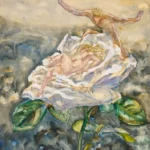
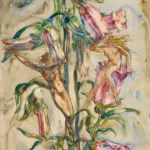
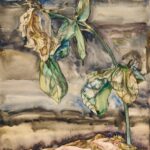
Gehri’s work spans genre scenes, landscapes, and silhouettes, as well as portraiture and book illustration. His legacy, though significantly diminished by the wartime destruction of his studio, endures through the works preserved in Freiburg and through the generation of artists he trained in Karlsruhe.