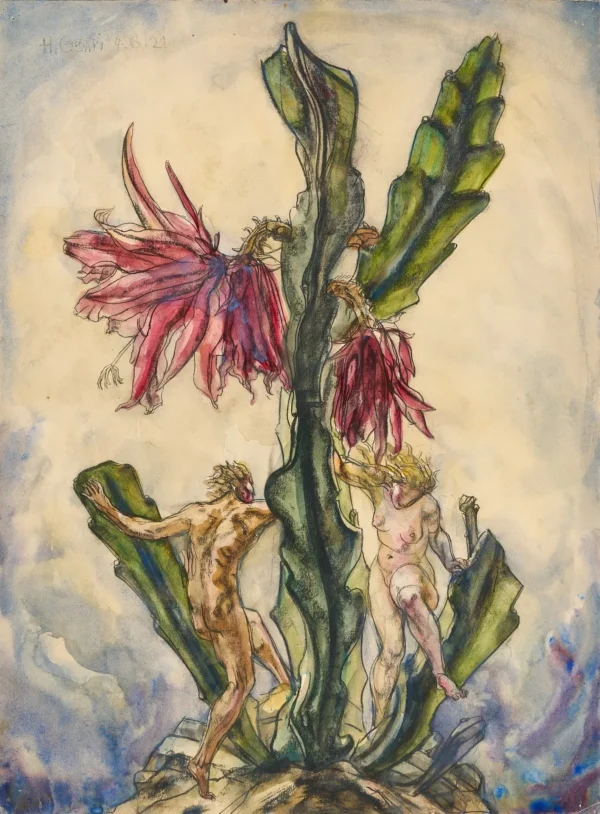
Watercolour on paper, 1921, signed and dated upper left: “H. Gehri 4.6.21”
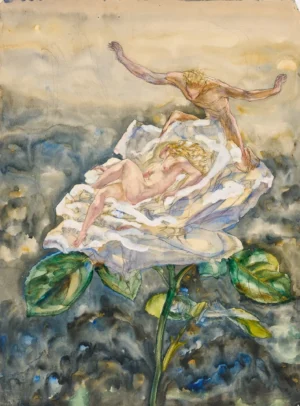
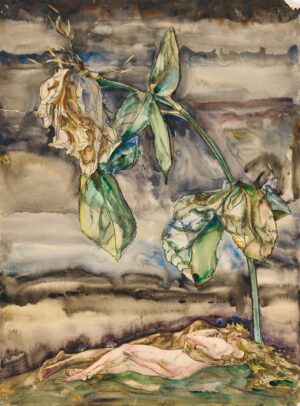
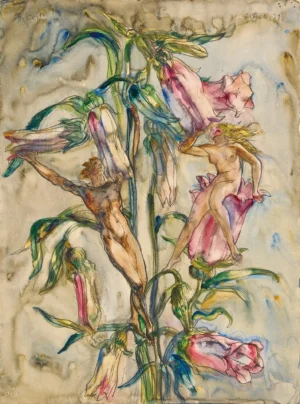
Two nude figures cling to a flowering cactus, their bodies moving with the same rhythm as the plant itself. Above them, three pink blossoms hang heavy and full — but already starting to fade. This watercolour feels like a celebration of love and joy, while reminding us how short and fragile life really is. Like the flowers above, beauty blooms — and slowly wilts, petal by petal. It’s part of a series of watercolours where Gehri painted human figures merging with plants, blending body and nature in beautiful, dreamlike scenes.
Painted the year after Gehri was appointed Professor of Figure Drawing at the Badische Landeskunstschule in Karlsruhe, the work captures everything that made him beloved by his students: a luminous palette, a sinuous line, and an unmistakable sense of poetry.
A German painter trained in Dresden and Karlsruhe, with formative travels through Japan, Italy and Paris, Gehri was dismissed from his professorship by the Nazis in 1933 and labelled a “degenerate” artist in 1937. He died in the bombing of Freiburg in November 1944, which destroyed his studio and much of his life’s work.
This is why Hermann Gehri remains such a rare artist today; every surviving sheet is a small miracle of preservation.